


Project Superhawk Dragbike


Senior Member
MotoGP
Joined: Mar 2007
Posts: 3,132
From: Phoenix, AZ

I never understood the people who do this to road bikes.. It's like: "Let's take the thing these bikes are best at (cornering) and remove that ability, now we are riding plastic covered harleys, only uglier."

Thread Starter
Senior Member
Back Marker
Joined: Jul 2008
Posts: 246
From: Big Island, HI
you have your hawk to burn up the twisties, i have mine to burn up the straight-a-ways
Senior Member
MotoGP
Joined: Mar 2007
Posts: 3,132
From: Phoenix, AZ
I get it for racing, most race vehicles look goofy. lol But on a road bike it is akin to the big wings on the back of civics. Just something that I don't understand.
Thread Starter
Senior Member
Back Marker
Joined: Jul 2008
Posts: 246
From: Big Island, HI
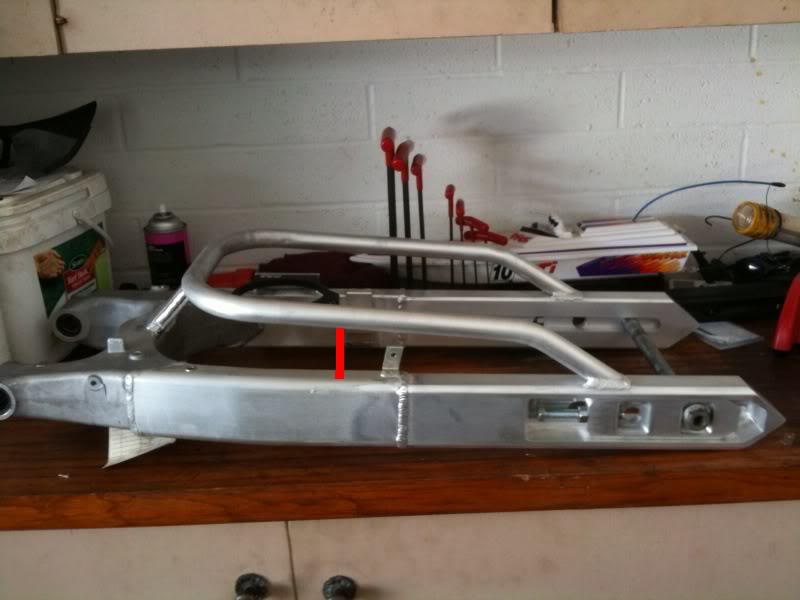
So would you say, where the red line is, it would be good to add supports between the upper brace and swingarm?

Out of my mind, back in 5
MotoGP
Joined: Nov 2006
Posts: 6,109
From: Skurup, Sweden
Yep, about there should work fine, and for aesthetic reasons mostly I'd probably make it either two tubes in an "A" or a thick alu plate slant cut on both sides, the same angle as the bend on the rear of the tube... Since you are asking that is...
BTW the fabrication on that looks really good...
BTW the fabrication on that looks really good...



Senior Member
Back Marker
Joined: Jul 2008
Posts: 243
From: Toronto, Ontario
is that addon you welded on the stock swingarm billet one piece alumium or is it steel tubing with billet pieces welded to it? if its a full billet piece id will be pretty stiff...
btw, it looked bettet with the hi-mounts...
btw, it looked bettet with the hi-mounts...

Senior Member
Back Marker
Joined: Jun 2007
Posts: 158
By the way I think it's a nice start. I too am into drag racing my bike (and cars) rather than tearing up the twisties so I get what you're doing. I think some triangulated tubular bracing on the swingarm will not only strengthen it a lot but also compliment the triangulated frame. Just my .02
________
Prilosec problems
________
Prilosec problems
Last edited by Malice; May 1, 2011 at 07:40 AM.

Senior Member
SuperSport
Joined: Dec 2005
Posts: 963
From: Sunshine Coast, Australia
thanks, i only plan on a 50hp shot, only to compinsate for a muffed start whether its breaks the tire loose or jumps high, just to get that quick shot to get back into my bracket number..i dont on planning the juice every pass, just there for the make up if need be for a quick second. its hard to play this game, but i have been very good in the past. just need a track here and its on
Revolution Racing in the UK may be able to advise you on this, and possibly source a billet crank for you as well, if you are that keen on this power output.
Thread Starter
Senior Member
Back Marker
Joined: Jul 2008
Posts: 246
From: Big Island, HI
yea getting around to finishing things up a little more. yea i wish i could keep the high mounts, they cost me enough to get, but will not work because they go inside the rear passenger pegs and upper swingarm brace hits with no clearance, because i lowered it. had to go with low mounts. or the second option would have been cut the devil cans down half the size and extend the mid pipes so that the tip of the cans would stay at there original position. didnt want to do that to a $875 exhaust. i figured someone else could use them more than i could. i would rather cut up the D&D's to make a custom exhaust than those Devil's. more pics to come down the rode. thanks for the compliments on "my style superhawk". 

Senior Member
SuperSport
SuperSport
Joined: Dec 2006
Posts: 880
From: Victoriaville, Quebec, Canada
The VTR crank can take more than this, I agree 150 HP of high RPM will destroy the crank for sure, but using a torque adder it will be fine, as long as there is some timing retard.
Senior Member
SuperSport
Joined: Dec 2005
Posts: 963
From: Sunshine Coast, Australia
Plenty of race bikes have been built in the past, and this is where I got this info from. It is not a personal opinion, but one that has come from engine builders that have developed race engines for the VTR. They should know. Too much risk I think.
Senior Member
SuperSport
SuperSport
Joined: Dec 2006
Posts: 880
From: Victoriaville, Quebec, Canada
My point is that in racing power adders are not permitted, the only ways left to increase power is to fill the cylinders as much as possible using airboxes, cold air, stacks, cam timing, etc..
And increase the amount of cylinder fillings, so the redline.
So they could not achieve more than 50 hp because past a certain RPM the crank would fail.
Every turn the crank fold and unfold from the weight of the pistons and rods, the force applied is half the square of RPM, so non linear, it goes trough various resonant frequency too, it will basically self destruct without much help from the combustion process even if the high speed pounding induce extra stress.
The metal heats up, form hot spots and break.
Power adders will increase the combustion force, making the crank twist in a totally different way than the high RPM stuff, the crank is so stiff this way that, I need to see one break before the rods to believe it.
In forced induction, the rods usually become the weak point, but there is virtually no documentation on how strong are the VTR rods.
Héhé sorry for the thread jack, I'm a big forced induction beliver


Senior Member
Back Marker
Joined: Jun 2007
Posts: 158
Last edited by Malice; May 1, 2011 at 07:41 AM.
Senior Member
SuperSport
Joined: Dec 2005
Posts: 963
From: Sunshine Coast, Australia
I'm not doubting that those guys pushed the envelope further than anyone will ever do.
My point is that in racing power adders are not permitted, the only ways left to increase power is to fill the cylinders as much as possible using airboxes, cold air, stacks, cam timing, etc..
And increase the amount of cylinder fillings, so the redline.
So they could not achieve more than 50 hp because past a certain RPM the crank would fail.
Every turn the crank fold and unfold from the weight of the pistons and rods, the force applied is half the square of RPM, so non linear, it goes trough various resonant frequency too, it will basically self destruct without much help from the combustion process even if the high speed pounding induce extra stress.
The metal heats up, form hot spots and break.
Power adders will increase the combustion force, making the crank twist in a totally different way than the high RPM stuff, the crank is so stiff this way that, I need to see one break before the rods to believe it.
In forced induction, the rods usually become the weak point, but there is virtually no documentation on how strong are the VTR rods.
Héhé sorry for the thread jack, I'm a big forced induction beliver
My point is that in racing power adders are not permitted, the only ways left to increase power is to fill the cylinders as much as possible using airboxes, cold air, stacks, cam timing, etc..
And increase the amount of cylinder fillings, so the redline.
So they could not achieve more than 50 hp because past a certain RPM the crank would fail.
Every turn the crank fold and unfold from the weight of the pistons and rods, the force applied is half the square of RPM, so non linear, it goes trough various resonant frequency too, it will basically self destruct without much help from the combustion process even if the high speed pounding induce extra stress.
The metal heats up, form hot spots and break.
Power adders will increase the combustion force, making the crank twist in a totally different way than the high RPM stuff, the crank is so stiff this way that, I need to see one break before the rods to believe it.
In forced induction, the rods usually become the weak point, but there is virtually no documentation on how strong are the VTR rods.
Héhé sorry for the thread jack, I'm a big forced induction beliver
Nitrous I don't know about. I don't think you can compare it with forced induction in regards to the stress on components. One sure way to find out though!



Senior Member
SuperBike
Joined: Oct 2008
Posts: 1,033
If its actually going to see the strip, then I love it. Glad its not for "looks"
Here is my list of things I would do, other than motor work, to make it quicker.
Lighter headlight, front subframe - fairing assembly.
One front rotor - caliper.
lighter battery.
This is how I decided to brace my stock length swingarm. I feel its a good compromise of weight vs strength.

keep up the good work.
Here is my list of things I would do, other than motor work, to make it quicker.
Lighter headlight, front subframe - fairing assembly.
One front rotor - caliper.
lighter battery.
This is how I decided to brace my stock length swingarm. I feel its a good compromise of weight vs strength.
keep up the good work.

Thread
Thread Starter
Forum
Replies
Last Post


