


BURNOUTS!!??

Senior Member
SuperSport
Joined: Aug 2007
Posts: 714
From: Fredericksburg, VA

In reference to the force: When using a wall, the rider is more likely to use improper technique and load the front end longer while the rear tire is building enough force to overpower the friction (traction).
Using the front brake only, the rider has no choice but to rapidly exceed that friction point without overpowering the friction in the front tire contact patch.
Another way of saying it is, the wall will let the rider do a slower "burnout" thereby creating more "traction" in the rear causing a greater torsional load to be applied to the front end for a longer time.
The front brake method requires the rider to rapidly minimize rear traction to a value less than the front tire's traction unless said rider is trying to wash the front end out resulting in less torsional load on the front for a shorter period of time.
I would think the bike is designed to handle front brake load rather than offset "wall" load. A force too great will cause the front to slide, preventing undesigned force to be applied to the forks. I've seen a hundred Harleys do "wall burnouts" and to my knowledge, there was never any damage to the forks, frame, or steering head.
Using the front brake only, the rider has no choice but to rapidly exceed that friction point without overpowering the friction in the front tire contact patch.
Another way of saying it is, the wall will let the rider do a slower "burnout" thereby creating more "traction" in the rear causing a greater torsional load to be applied to the front end for a longer time.
The front brake method requires the rider to rapidly minimize rear traction to a value less than the front tire's traction unless said rider is trying to wash the front end out resulting in less torsional load on the front for a shorter period of time.
I would think the bike is designed to handle front brake load rather than offset "wall" load. A force too great will cause the front to slide, preventing undesigned force to be applied to the forks. I've seen a hundred Harleys do "wall burnouts" and to my knowledge, there was never any damage to the forks, frame, or steering head.

Out of my mind, back in 5
MotoGP
Joined: Nov 2006
Posts: 6,109
From: Skurup, Sweden
In reference to the force: When using a wall, the rider is more likely to use improper technique and load the front end longer while the rear tire is building enough force to overpower the friction (traction).
Using the front brake only, the rider has no choice but to rapidly exceed that friction point without overpowering the friction in the front tire contact patch.
Another way of saying it is, the wall will let the rider do a slower "burnout" thereby creating more "traction" in the rear causing a greater torsional load to be applied to the front end for a longer time.
The front brake method requires the rider to rapidly minimize rear traction to a value less than the front tire's traction unless said rider is trying to wash the front end out resulting in less torsional load on the front for a shorter period of time.
I would think the bike is designed to handle front brake load rather than offset "wall" load. A force too great will cause the front to slide, preventing undesigned force to be applied to the forks. I've seen a hundred Harleys do "wall burnouts" and to my knowledge, there was never any damage to the forks, frame, or steering head.
Using the front brake only, the rider has no choice but to rapidly exceed that friction point without overpowering the friction in the front tire contact patch.
Another way of saying it is, the wall will let the rider do a slower "burnout" thereby creating more "traction" in the rear causing a greater torsional load to be applied to the front end for a longer time.
The front brake method requires the rider to rapidly minimize rear traction to a value less than the front tire's traction unless said rider is trying to wash the front end out resulting in less torsional load on the front for a shorter period of time.
I would think the bike is designed to handle front brake load rather than offset "wall" load. A force too great will cause the front to slide, preventing undesigned force to be applied to the forks. I've seen a hundred Harleys do "wall burnouts" and to my knowledge, there was never any damage to the forks, frame, or steering head.

Another theory about why Hardly guys use a wall... crappy brakes?!
I know the engine is kinda low on horsepower and revs, but it does have torque... and the brakes on all Harley's I have been on have been somewhere between a joke and a prayer... Hence the need for a wall...
ATGATT
Superstock
Joined: Jul 2007
Posts: 253
From: South of Nashvegas TN
burnin
Now that everyone has officially given Pimp an answer he is probably thinking twice about trying his first burnout... My wife and I began to cring watching the dude in the video load up the revs trying to burnout. We just knew something bad was going to happen. Bike+Idiot+camera = youtubegold.

Senior Member
Back Marker
Joined: Apr 2007
Posts: 147
From: Minnesota
Wow. Thread ruined
Well, congratulations to all you bickering women, you have now just destroyed this thread with all of your arguing.  Why don't you just leave all that there smarts stuff where it belongs...in da books. Let the burnout stand!
Why don't you just leave all that there smarts stuff where it belongs...in da books. Let the burnout stand!
Senior Member
MotoGP
Joined: Mar 2007
Posts: 3,132
From: Phoenix, AZ
I hate to do this but could not let it go.
Accroding to newton's law of motion
The principle of motion can be derived. Which was first thought of
by Archimedes.
The amount of work done is given by force times distance.
So if the force is applied 12" higher on the tire(i measured) it changes
the force applied to the steering head. We can look at the forks as simply
a first class lever if you shorten the lever the force applied is less at the fulcrum. Ever used a "Cheater" in a wrench or a rachet ? The longer the cheater the more force applied to the item you are attempting to move. So reducing the length of the cheater would result in a diminished amount
of force to the item. Now with that said lets take into consideration the torsion on the forks from the brake calipers biting down on the rotors wich are attached to the forks (this is using the no wall/tree method)would apply a different force to the forks causing them to flex theoreticly in the middle of the two points of attachment (steering head and axle pin).
While the bike is designed for these types of loads/forces in your statement. You said that the forces on the forks/steering head would be the same. Which i believe is a incorrect statement.
Now i will shut up.
Accroding to newton's law of motion
The principle of motion can be derived. Which was first thought of
by Archimedes.
The amount of work done is given by force times distance.
So if the force is applied 12" higher on the tire(i measured) it changes
the force applied to the steering head. We can look at the forks as simply
a first class lever if you shorten the lever the force applied is less at the fulcrum. Ever used a "Cheater" in a wrench or a rachet ? The longer the cheater the more force applied to the item you are attempting to move. So reducing the length of the cheater would result in a diminished amount
of force to the item. Now with that said lets take into consideration the torsion on the forks from the brake calipers biting down on the rotors wich are attached to the forks (this is using the no wall/tree method)would apply a different force to the forks causing them to flex theoreticly in the middle of the two points of attachment (steering head and axle pin).
While the bike is designed for these types of loads/forces in your statement. You said that the forces on the forks/steering head would be the same. Which i believe is a incorrect statement.
Now i will shut up.
I think that because of the axle being the point where the force is applied in both situations, it is the end of the lever..
You can't count the wheel as a "cheater bar" because it isn't actually adding to the length of the forks.
I am sure there are more complicated issues involved, twisting force from the brakes, etc.
Any physicists in the house?
Out of my mind, back in 5
MotoGP
Joined: Nov 2006
Posts: 6,109
From: Skurup, Sweden
Well... I did actually answear that question... but again... in a different way...
The wheel is part of the cheater bar, but the main part is the fork... it's just that the fork is angled... so the last part of the cheater bar is vertical ie the distance from the axle down... and then you have the torsional force applied by the brakes forward on the fork... so yes it's complicated...
However with the wall the cheater bar is the fork only... and there is no torsional force from the brakes...
So no, they are not the same...
The wheel is part of the cheater bar, but the main part is the fork... it's just that the fork is angled... so the last part of the cheater bar is vertical ie the distance from the axle down... and then you have the torsional force applied by the brakes forward on the fork... so yes it's complicated...
However with the wall the cheater bar is the fork only... and there is no torsional force from the brakes...
So no, they are not the same...
Out of my mind, back in 5
MotoGP
Joined: Nov 2006
Posts: 6,109
From: Skurup, Sweden
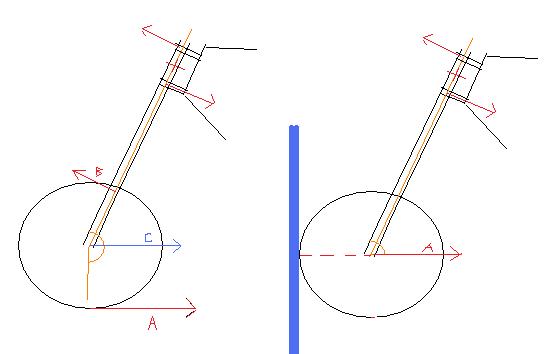
Ok... the force A is always the same as the driving force from the rear wheel... ie burnout... otherwise you are pushing the front...
With the wall the force can be moved along it's axis as it's angle is unchanged...
Without the wall the force C is the resulting force of the force's A and B and thier respective angles and leverages... with the front wheel axle acting as the center of the force's A&B, C then acts at the fork from that point...
And yes... there are about a hundred other forces to actually calculate in there for it to come close to reality...
Last edited by Tweety; Apr 5, 2008 at 06:19 PM.
ATGATT
Superstock
Joined: Jul 2007
Posts: 253
From: South of Nashvegas TN
back on track
Here you go Pimp.. this might help get you motivated if the science talk has you distracted. Classic hawk burnout blowing the tire:
http://www.youtube.com/watch?v=gSCbF4UTOms
Don't forget to find someone to wipe your bike clean when your done.
http://www.youtube.com/watch?v=gSCbF4UTOms
Don't forget to find someone to wipe your bike clean when your done.
Senior Member
Back Marker
Back Marker
Joined: Sep 2007
Posts: 103
From: Thousand Oaks, CA
Heres a good burnout, but i think where he decided to do it was in the wrong place.http://www.youtube.com/watch?v=-qAOu6QQMYM
Member
Squid
Joined: Apr 2008
Posts: 47
From: New Zealand
Burnout
Remember that when you stop it keep hold of the front brake and pull the clutch in , because if you,ve let a bit of pressure off the brake once the rear spins and you get off the gas without pulling the clutch it will get traction . AND WHEN YOU **** OFF , And everyone is rolling around on the ground laughing , so will we if you post the pics.
Have Fun
Have Fun
I could ride in
SuperBike
Joined: Sep 2007
Posts: 1,729
From: Dayton, TN
twin wheeled burnout skills

Senior Member
MotoGP
Joined: Mar 2007
Posts: 3,132
From: Phoenix, AZ
Attachment 2436
Ok... the force A is always the same as the driving force from the rear wheel... ie burnout... otherwise you are pushing the front...
With the wall the force can be moved along it's axis as it's angle is unchanged...
Without the wall the force C is the resulting force of the force's A and B and thier respective angles and leverages... with the front wheel axle acting as the center of the force's A&B, C then acts at the fork from that point...
And yes... there are about a hundred other forces to actually calculate in there for it to come close to reality...
Ok... the force A is always the same as the driving force from the rear wheel... ie burnout... otherwise you are pushing the front...
With the wall the force can be moved along it's axis as it's angle is unchanged...
Without the wall the force C is the resulting force of the force's A and B and thier respective angles and leverages... with the front wheel axle acting as the center of the force's A&B, C then acts at the fork from that point...
And yes... there are about a hundred other forces to actually calculate in there for it to come close to reality...


