


The truth about VTR frame and Spondon "ears"

Thread Starter
Senior Member
MotoGP
Joined: Apr 2005
Posts: 5,631
From: Montreal

The truth about VTR frame and Spondon "ears"
Taken from the vtr1000.org site in a post by Roger Ditchfield himself:
"Hi Guys, In this thread there has been several references to the "ears" in the Spondon frame. This the story. The development of the VTR was originally given to Russell Savoury by Honda UK who employed the services of Mick Grant as a consultant. After more than a year the project had failed to achieve too much progress and while I was at the Suzuka 8 hour I was asked by HRC if I would be interested in taking over the project. I agree provided that Russel was happy to do that - which he was. When I took over and uplifted all the bikes and equipment from Harlow I had five modified frames. Enquiries revealed that Spondon were asked to do this by Mick to cure high speed straight line weaving. I then examined the dampers that had arrived only to find that they had been extended between 15mm and 25mm centre eye to centre eye longer than standard of 345mm! IMHO the "ears" were fitted in an attempt to cure a self inflicted problem. As already mentioned in previous posts no ST3 race bikes producing far more power than Russels best of 118bhp ever ran with this modification including mine. The standard frame was modified and I have done this modification on two customer bikes in the UK. I left the Spondon ears on my ST2 Production race bikes purely because they did no harm to the new Revolution suspension set up and the then ACU Minimum Race Weight Regulation for that class allowed then to stay there. If you have a VTR bike exceeding 135bhp I recommend the Standard frame modifications as used on all ST3s"
here is the link: www.vtr1000.org • View topic - New bike - Moriwaki race vtr
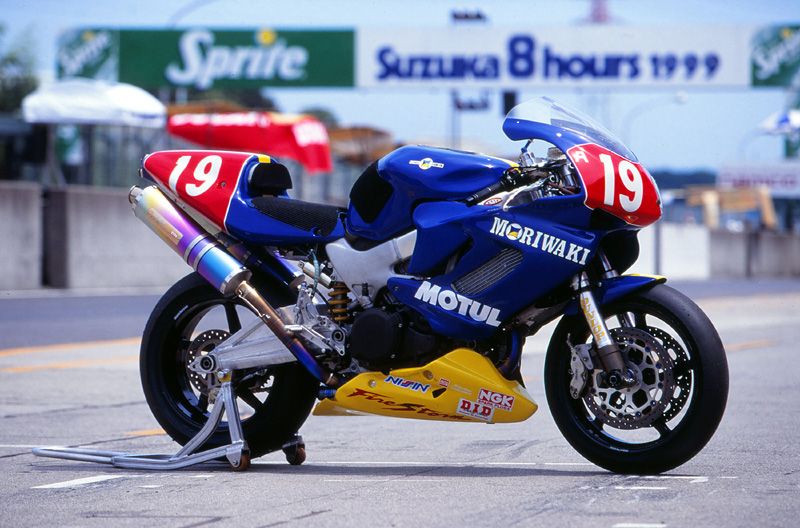
And here is the cherry for that sundae, a pic of the Moriwaki Stage 3 bike that ran at Suzuka in 1999:

"Hi Guys, In this thread there has been several references to the "ears" in the Spondon frame. This the story. The development of the VTR was originally given to Russell Savoury by Honda UK who employed the services of Mick Grant as a consultant. After more than a year the project had failed to achieve too much progress and while I was at the Suzuka 8 hour I was asked by HRC if I would be interested in taking over the project. I agree provided that Russel was happy to do that - which he was. When I took over and uplifted all the bikes and equipment from Harlow I had five modified frames. Enquiries revealed that Spondon were asked to do this by Mick to cure high speed straight line weaving. I then examined the dampers that had arrived only to find that they had been extended between 15mm and 25mm centre eye to centre eye longer than standard of 345mm! IMHO the "ears" were fitted in an attempt to cure a self inflicted problem. As already mentioned in previous posts no ST3 race bikes producing far more power than Russels best of 118bhp ever ran with this modification including mine. The standard frame was modified and I have done this modification on two customer bikes in the UK. I left the Spondon ears on my ST2 Production race bikes purely because they did no harm to the new Revolution suspension set up and the then ACU Minimum Race Weight Regulation for that class allowed then to stay there. If you have a VTR bike exceeding 135bhp I recommend the Standard frame modifications as used on all ST3s"
here is the link: www.vtr1000.org • View topic - New bike - Moriwaki race vtr
And here is the cherry for that sundae, a pic of the Moriwaki Stage 3 bike that ran at Suzuka in 1999:
Last edited by mikstr; Jan 25, 2013 at 06:44 AM.


Senior Member
MotoGP
Joined: Jul 2010
Posts: 3,871
From: Phoenix, AZ
Now THAT is interesting. For clarification, we're talking about the two tabs that extend from the rear frame engine mounts to the swing arm engine mount on the bike, yeah?
So according to this, these aren't really to support the swingarm in the frame, they're just to correct a spacing mistake made at Spondon? Instead, the bracing inside the frame is all that's really needed....
From an eyeball engineering standpoint, I could see this happening... it's a pretty big chunk of aluminum that the swing arm attaches to... and the ears aren't fully braced... they probably add some stiffness but they are kind of flex tabs sticking out.
So according to this, these aren't really to support the swingarm in the frame, they're just to correct a spacing mistake made at Spondon? Instead, the bracing inside the frame is all that's really needed....
From an eyeball engineering standpoint, I could see this happening... it's a pretty big chunk of aluminum that the swing arm attaches to... and the ears aren't fully braced... they probably add some stiffness but they are kind of flex tabs sticking out.
Thread Starter
Senior Member
MotoGP
Joined: Apr 2005
Posts: 5,631
From: Montreal
Essentially, what Roger is saying is that the ears were added to correct a straight-line stability issue. In other words, early on in the development process, the lack of stability was (in retrospect, erroneously) attributed to flex in the swingarm pivot area. The proposed remedy was thus to reinforce this area by adding extra support via the "ears". However, as Roger points out, closer inspection revealed that the instability was misdiagnosed and was, in fact, caused by excessive rear ride height (adding 15 to 25mm to the rear shock length would, due to linkage multiplication, generate a rise in rear ride height of about 50 - 90mm). Once this (excessive) shock length was removed, it would appear that the instability problem went away. That, in a nutshell, is it.
Last edited by mikstr; Jan 25, 2013 at 07:55 AM.

Senior Member
SuperSport
Joined: Mar 2010
Posts: 987
From: Asheville, North Carolina
From engineering standpoint, Structurally tying the frame to the "Flex point of the suspension " Would make easier setting up the suspension, and help control "Flex and twist " when exiting curves....
"attributed to flex in the swingarm pivot area. The proposed remedy was thus to reinforce this area by adding extra support via the "ears".
How beautiful that site is... just wow......
"attributed to flex in the swingarm pivot area. The proposed remedy was thus to reinforce this area by adding extra support via the "ears".
How beautiful that site is... just wow......
Last edited by 1971allchaos; Jan 25, 2013 at 11:09 AM.
Thread Starter
Senior Member
MotoGP
Joined: Apr 2005
Posts: 5,631
From: Montreal

Senior Member
SuperBike
Joined: Jul 2011
Posts: 1,461
From: South of Live Free or Die & North of Family Guy
I never understood how exactly the ears adding stability, it seemed a bit wrong to me, so what is Roger saying is that the instability is due to the linkage. I'm a little confused now, how is the linkage effecting on instability at the pivot area? And so the only remedy you really need is to drop the height ride??? Is this got to do with the flexing at all? Or more like the geometry of the bike?
Thread Starter
Senior Member
MotoGP
Joined: Apr 2005
Posts: 5,631
From: Montreal
The instability came from an an overly long shock (which raised the rear excessively, in so doing reducing the rake and trail, and adding a bunch of weight over the front end). The ONLY function of the linkage in the discussion is that the shock acts on the swingarm through a linkage. This linkage operates with leverage to multiply the shock's limited travel to produce the 120mm or so of travel for the rear suspension. The shock stroke is nowhere near 120mm so the linkage (together with its position on the swingarm) works to "leverage" the limited stroke to give acceptable travel to the rear suspension.
Senior Member
SuperBike
Joined: Jul 2011
Posts: 1,461
From: South of Live Free or Die & North of Family Guy
The instability came from an an overly long shock (which raised the rear excessively, in so doing reducing the rake and trail, and adding a bunch of weight over the front end). The ONLY function of the linkage in the discussion is that the shock acts on the swingarm through a linkage. This linkage operates with leverage to multiply the shock's limited travel to produce the 120mm or so of travel for the rear suspension. The shock stroke is nowhere near 120mm so the linkage (together with its position on the swingarm) works to "leverage" the limited stroke to give acceptable travel to the rear suspension.

Senior Member
SuperBike
Joined: Aug 2005
Posts: 1,864
From: Fort Wayne, IN
The swingarm pivot area of the VTR's chassis is for sure one it's weak points. Anyone who has put their VTR on the track can attest to this. The flex in that area causes the chassis to "wind up" during hard cornering. This effectively simulates a bent frame. The excessive flex makes the VTR a terrific street bike but hurts it when pushed hard.
I've been working on my own version of something like this off and on for the past couple of years. I think it is a valuable upgrade.
I've been working on my own version of something like this off and on for the past couple of years. I think it is a valuable upgrade.
Thread Starter
Senior Member
MotoGP
Joined: Apr 2005
Posts: 5,631
From: Montreal
There is no doubt a reason Honda put such a robust frame (and ran the swingarm pivot through it) on the RC51 (a quasi-offspring of the VTR if you will), and that reason has to be the extra rigidity needed when dicing it out for champioships on tracks around the world. However, to say that your engine cases will instantly disintegrate if you get over 120 hp as some would have us believe is obviously urban legend.....
Senior Member
SuperBike
Joined: Aug 2005
Posts: 1,864
From: Fort Wayne, IN
Not sure that I've ever heard that before, but I agree that it's not grounded in fact. Suspension loads are much greater than engine drive force.


Out of my mind, back in 5
MotoGP
Joined: Nov 2006
Posts: 6,109
From: Skurup, Sweden
I think you are confuing two such urban myths a little mikstr... One being that the 130+ bhp engines would self destruct due to a weak bearing/wrist pin seating... And that as far as I know is still unproven either way... The "urban myth" you are talking about is that 130+ bikes and others would need the ears to strengthen the casings...
And I still say that regardless of Rogers lesson on history, I still think it's valid... One, he's talking about racebikes... They have a measured lifespan in x race starts... Not years... Two, even if the ears was originally for stability, to fix a problem, they are infact strengthening the weakest point of the frame in terms of flex, which has a benefit for chassie setup... And more importantly, three... The swingarm bolts directly to the casings, in a way that's not exactly high strength in terms of how crash durable it is... I have seen more than one crashed VTR where the swingarm ripped from the engine casing, or the casing was cracked, as it hit a curb or similar in the wrong place...
So, while it isn't necessary, on 130+ hp, or lower... I still say that it's a good idea if you are going to use the bike on track, since you reduce flex, and add crash durability and potentially lifespan to your engine casings...
With Rogers lesson, I see them more like the crashprotectors, and to be honest, I never thought there was a magic bhp figure... But yeah, higher hp, higher load and stress on parts...
And I still say that regardless of Rogers lesson on history, I still think it's valid... One, he's talking about racebikes... They have a measured lifespan in x race starts... Not years... Two, even if the ears was originally for stability, to fix a problem, they are infact strengthening the weakest point of the frame in terms of flex, which has a benefit for chassie setup... And more importantly, three... The swingarm bolts directly to the casings, in a way that's not exactly high strength in terms of how crash durable it is... I have seen more than one crashed VTR where the swingarm ripped from the engine casing, or the casing was cracked, as it hit a curb or similar in the wrong place...
So, while it isn't necessary, on 130+ hp, or lower... I still say that it's a good idea if you are going to use the bike on track, since you reduce flex, and add crash durability and potentially lifespan to your engine casings...
With Rogers lesson, I see them more like the crashprotectors, and to be honest, I never thought there was a magic bhp figure... But yeah, higher hp, higher load and stress on parts...
Thread Starter
Senior Member
MotoGP
Joined: Apr 2005
Posts: 5,631
From: Montreal
I guess my attempt at sarcasm was perhaps over the top and led a few astray. I realise that the crank snapping and case snapping issues are two separate items.
I am also not in any ways saying that the "ears" are not a worthy addition. I have never been a fan of "frameless" swingarm pivot points such as on the VTR (and 929/954). Handling and crash durability aside, I fail to see how adding unnecessary stress to this area can have any potential benefits (stress can and will inevitably result in flex, and have undesirable effects on the numerous shafts and gears which are designed to run in fixed position). In other words, I question the entire premise of this design but, alas, my bike uses this design......
Would I like to have "ears" on my frame? Yessir!!!! However, the underlying message as I understand it is that they are not 100% necessary, not on a streetbike anyhow. Massaging your engine to develop over 120 hp will not inevitably result in failure of the case area uner normal use and this goes against certain urban legends which claim that crossing the 120 hp threshold is an instant recipe for disaster (ie. cracked cases).
I am also not in any ways saying that the "ears" are not a worthy addition. I have never been a fan of "frameless" swingarm pivot points such as on the VTR (and 929/954). Handling and crash durability aside, I fail to see how adding unnecessary stress to this area can have any potential benefits (stress can and will inevitably result in flex, and have undesirable effects on the numerous shafts and gears which are designed to run in fixed position). In other words, I question the entire premise of this design but, alas, my bike uses this design......
Would I like to have "ears" on my frame? Yessir!!!! However, the underlying message as I understand it is that they are not 100% necessary, not on a streetbike anyhow. Massaging your engine to develop over 120 hp will not inevitably result in failure of the case area uner normal use and this goes against certain urban legends which claim that crossing the 120 hp threshold is an instant recipe for disaster (ie. cracked cases).
Member
Squid
Joined: Sep 2010
Posts: 55

Seriously though, while all the engineering reasoning behind the "ears" is over my head, I have seen those on my mechanic's VTR, (Bart / Faster Motorsports / Denver). I thought a large part of the purpose of them was to adapt standard aftermarket rearsets to the VTR. I believe Bart also told me his VTR put out about 130 hp.
Last edited by SloBlue; Jan 26, 2013 at 07:38 AM.

Banned
MotoGP
Joined: Aug 2007
Posts: 5,942
From: Lake View Terrace, CA


Senior Member
Back Marker
Joined: Apr 2010
Posts: 219
From: Prague - Czech
The swingarm pivot area of the VTR's chassis is for sure one it's weak points. Anyone who has put their VTR on the track can attest to this. The flex in that area causes the chassis to "wind up" during hard cornering. This effectively simulates a bent frame. The excessive flex makes the VTR a terrific street bike but hurts it when pushed hard.
I've been working on my own version of something like this off and on for the past couple of years. I think it is a valuable upgrade.
I've been working on my own version of something like this off and on for the past couple of years. I think it is a valuable upgrade.
Of course depends on rider - weight, riding style, and skills.
Banned
MotoGP
Joined: Aug 2007
Posts: 5,942
From: Lake View Terrace, CA


Senior Member
Superstock
Joined: May 2012
Posts: 397
From: UK
The swingarm bolts directly to the casings, in a way that's not exactly high strength in terms of how crash durable it is... I have seen more than one crashed VTR where the swingarm ripped from the engine casing, or the casing was cracked, as it hit a curb or similar in the wrong place...

"Sorry what was that, I can't hear you" LOL
(:-})
Seasoned tech
SuperSport
Joined: Apr 2012
Posts: 576
From: Issaquah, WA
It's interesting, I belive it was when they first came out I thought I heard or read something saying that this type of swingarm attachment actualy made for a more rigid setup due to that the engine casings don't flex as much as the frame does. Afterall there is a lot more webbing and structural walls in the engine making it more rigid than the frame. I can't see where tieing them in together would be a bad thing and I've actually talked to a friend who is a structural engineer about making some ears to put on my bike as well as to sell to those who want them. I can see how an impact could be more prone to brake the engine cases but that load is many times more than any loads exerted by the bike itself either by the power of a 130+ hp or by high speed cornering. Also being more rigid than the frame would mean it wouldn't flex as much in an impact and be more likely to break where the frame would be more likely to just bend.
One more thing to point out is that he claims that bike in the pic had no more than 119hp. So it's not even relatively close to that 130+hp mark anyway.
And yeah I'm with you Hawk, that Dunlop sticker seems out of place. Looks like it may have been photoshoped in. Not sure why anyone would do that though. Weird.
One more thing to point out is that he claims that bike in the pic had no more than 119hp. So it's not even relatively close to that 130+hp mark anyway.
And yeah I'm with you Hawk, that Dunlop sticker seems out of place. Looks like it may have been photoshoped in. Not sure why anyone would do that though. Weird.
Out of my mind, back in 5
MotoGP
Joined: Nov 2006
Posts: 6,109
From: Skurup, Sweden
It's interesting, I belive it was when they first came out I thought I heard or read something saying that this type of swingarm attachment actualy made for a more rigid setup due to that the engine casings don't flex as much as the frame does. Afterall there is a lot more webbing and structural walls in the engine making it more rigid than the frame. I can't see where tieing them in together would be a bad thing and I've actually talked to a friend who is a structural engineer about making some ears to put on my bike as well as to sell to those who want them. I can see how an impact could be more prone to brake the engine cases but that load is many times more than any loads exerted by the bike itself either by the power of a 130+ hp or by high speed cornering. Also being more rigid than the frame would mean it wouldn't flex as much in an impact and be more likely to break where the frame would be more likely to just bend.
One more thing to point out is that he claims that bike in the pic had no more than 119hp. So it's not even relatively close to that 130+hp mark anyway.
And yeah I'm with you Hawk, that Dunlop sticker seems out of place. Looks like it may have been photoshoped in. Not sure why anyone would do that though. Weird.
One more thing to point out is that he claims that bike in the pic had no more than 119hp. So it's not even relatively close to that 130+hp mark anyway.
And yeah I'm with you Hawk, that Dunlop sticker seems out of place. Looks like it may have been photoshoped in. Not sure why anyone would do that though. Weird.
Ie yes, it's entirely true, it's actually more rigid in the bolting point than the frame as a whole... But it transfers the load to the frame, flexing there... Moving that load to the ears, make the engine and frame move with each other instead... And that makes for easier suspension tuning perhaps, but fairly marginal...
The big gains are still durability, crash protection, and the ability to remove the swingarm without the rearsets coming off... Makes it a lot easier on a track bike, but rather pointless on a roadbike... Secondary is added rigidity and better tunability...


